




Perseverance and a strong sense of responsibility are the driving forces behind Tran Dang Khoa’s constant efforts to improve production lines, upgrade equipment, and refine even the smallest technical operations. All of this is aimed at creating a better working environment, improving production efficiency, and honoring the true value of honest labor.
Passion for Improvement, Responsibility in Every Small Action
On a rainy afternoon in June in southern Vietnam, we visited The Southern Fertilizer Joint Stock Company to meet engineer Tran Dang Khoa. Dressed simply, Khoa stepped out from the production line area, his hands still stained with grease. His workplace is filled with the sound of running machines, concrete walkways, and production zones… Our first impression of him was his calm and reserved demeanor. Yet his eyes lit up when he spoke about production lines, technology, and unresolved technical challenges. A young engineer fully immersed in his profession, driven by responsibility and passion, that was immediately clear from our first meeting.
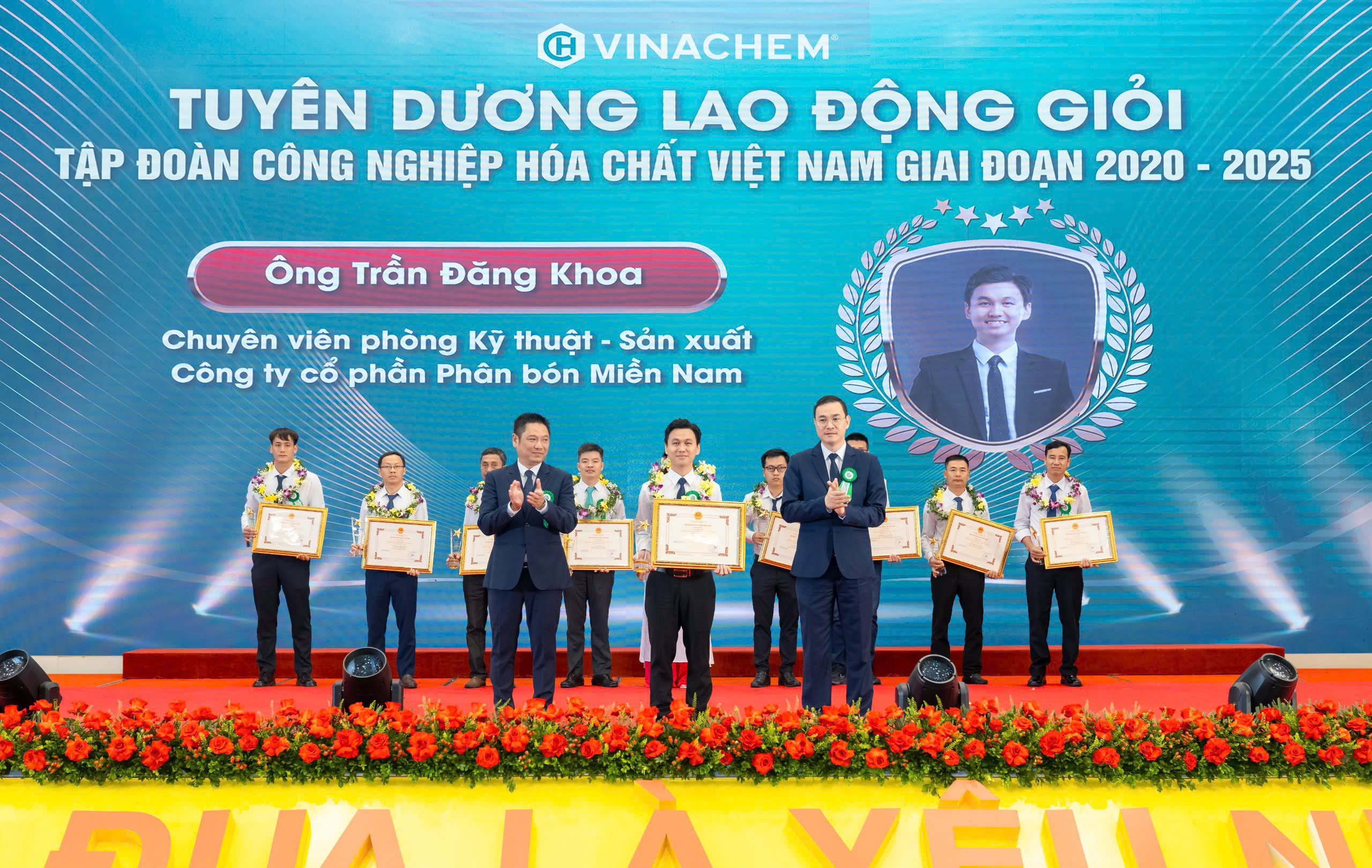
Tran Dang Khoa, a specialist in the Technical and Production Department of The Southern Fertilizer Joint Stock Company, is a young engineer who has quickly established himself as a core contributor to the company’s technical innovation initiatives. With a serious professional attitude, a mindset of continuous improvement, and a strong sense of responsibility, he has directly participated in two major technical initiatives that have generated economic benefits worth billions of VND for the company.
But beyond the economic figures, what left the strongest impression on us was his perspective on the profession itself: “For me, engineering has no destination, only moving forward or falling behind.” Khoa does not choose the easy path. He is the type of engineer who rolls up his sleeves, closely observes every small operation in the factory, worries when workers still face unnecessary hardship, dares to question outdated production lines, and is willing to dive into improvement work. His goal is not recognition or praise, but better efficiency, reduced physical strain for workers, more stable machinery, and higher product quality.
This mindset was clearly demonstrated in the first initiative he joined with his team: the design and renovation of the NPK mixing system at the Cuu Long Fertilizer Plant. For Khoa, this was not simply a technical calculation, but a comprehensive process of evaluation, analysis, and identifying bottlenecks.
The existing system reused equipment from a roller compaction line and faced multiple limitations, including insufficient dosing capacity for multiple raw materials, cramped working platforms, narrow conveyors, weak vibrating screens, uneven mixing, dust dispersion, time-consuming cleaning, and inconvenient finished product bagging.
The team proposed a comprehensive upgrade: increasing the number of dosing hoppers to allow more flexible material formulation, expanding work platforms and installing safety belts, redesigning the electrical control cabinet for easier operation, upgrading to wider conveyors to prevent spillage, integrating a rotary drum mixer and paddle mixer into the line, improving particle classification screening, installing dust collection covers, and adding intermediate conveyors for palletized bagging… Every detail, large or small, served a single objective: optimizing equipment, improving production efficiency, and enhancing working conditions for employees.
The total investment cost for the integrated NPK mixing system was over 5.3 billion VND. If the two mixing systems had been invested in separately, the cost would have exceeded 6.3 billion VND. As a result, the initiative helped the company save nearly 1 billion VND in initial investment costs, in addition to reducing annual maintenance expenses by approximately 250 million VND. The total economic benefit is estimated at 1.24 billion VND.
Behind these figures, however, was a long and demanding process. According to Tran Dang Khoa, the real challenge was not theoretical design, but ensuring practical constructability, technological suitability, cost feasibility, and compatibility with existing facilities. In particular, integrating two mixing systems with completely different operating principles while allowing flexible switching for different products was a complex task.
Another major initiative involving Tran Dang Khoa was the design and modification of equipment to convert superphosphate production from raw ore to processed ore at the Long Thanh Superphosphate Plant. This strategic initiative helped the company become more resilient to fluctuations in raw material markets. Surveying and reassessing the entire existing production line to determine conversion feasibility was far from simple. The solution had to maintain productivity while minimizing renovation costs and ensuring safety, technical performance, and visual standards.
Thanks to close coordination between the technical department and the plant, the upgraded production line was put into operation in February 2024 and delivered clear results: stable production, consistent product quality, reduced labor intensity for employees, streamlined equipment, and optimized operations.
No Innovation Is Born from… Paper
As someone directly involved in surveying, designing, and implementing construction work items, Tran Dang Khoa consistently took a proactive role throughout the entire process, from design and cost estimation to supervision, progress tracking, and final acceptance before commissioning equipment for production.
He also actively participates in training and skill certification for mechanical workers at affiliated plants and is one of the technical staff members who regularly propose machinery and equipment improvements, introduce new materials, update regulations, and disseminate them throughout the company. Khoa can be described as a vital link between theory and practice, between technical drawings and production efficiency. For him, innovation does not begin with grand ideas, but with a simple question: “Why not do it another way?” This mindset allows him to maintain a strong learning spirit, keen observation skills, and empathy for frontline workers, which is the key factor ensuring that innovations are implemented in real production rather than remaining on paper.
When asked what is most important for maintaining a spirit of innovation in a highly technical and process-driven industry like the chemical industry, he answered frankly: “I think it is responsibility. When you see work that needs to be done, you step in. When you see something unreasonable, you fix it. Innovation is not for praise, but to make the work better.” This is the mindset of a skilled craftsman who does not chase titles, but quietly sustains passion day by day.
Khoa shared that he constantly pushes himself to learn, because otherwise he would be “left behind by technology itself.” What keeps his passion alive after all these years? His belief in the value of honest labor. He believes that doing today just a little better than yesterday is already progress.
Looking ahead, Khoa plans to focus on two directions: continuing to improve equipment, especially in stages that still rely heavily on manual labor, moving toward automation and synchronization; and sharing practical experience with younger engineers so that “the spirit” of technical craftsmanship is passed on through real-world practice.